
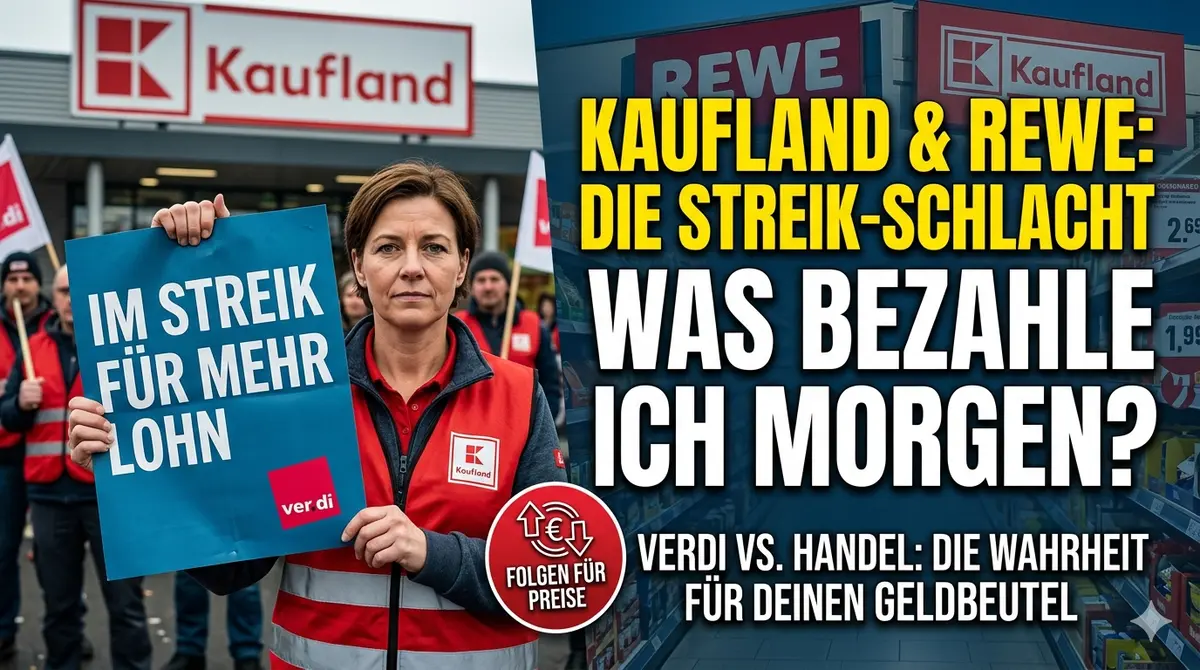
A massive wave of warning strikes (Warnstreiks Einzelhandel) has hit the German retail sector. Led by the powerful trade union ver.di, thousands of workers across retail giants like Kaufland and Rewe have walked out. Coming right around a popular long weekend, this coordinated labor dispute is sending ripples through the financial landscape, leaving consumers wondering about supply shortages and investors looking closely at corporate profit margins.
Here is an analytical look at the ongoing Einzelhandel Streik, the core financial standoffs, and how it impacts the broader economy.
The Catalyst: Why are Kaufland and Rewe Workers Striking?
The retail sector trade negotiations (Tarifverhandlungen), representing nearly 5.2 million workers across Germany, have hit a major roadblock. The union ver.di rejected the initial offers presented by employers, calling them „poisoned offers“ that fail to account for years of sticky inflation.
The Financial Tug-of-War:
- What ver.di Demands: A 7% increase in wages (or at least a minimum of €225 more per month) with a short 12-month contract duration to cushion employees against high living costs.
- What Employers Offered: A wage freeze for the first six months, followed by a 2% increase in November, and an additional 1.5% in August 2027.
According to ver.di, retail employees spend roughly 70% of their income on basic necessities like rent, food, and energy. With the current employer proposal offering below-inflation adjustments, the union argues it forces severe real-wage losses on low-wage workers.
Corporate Profits vs. Employee Wages: The Macro view
From a finance perspective, the Kaufland Streik and Rewe Streik highlight a growing friction between corporate revenues and labor costs.
| Metric | Financial Data (German Trade Sector) |
|---|---|
| Total Industry Revenue (2025) | Approx. €2.52 Trillion |
| Total Net Profits (Latest Annual) | Approx. €82.9 Billion |
| Average Retail Base Salary | ~€3,219 gross per month (from 6th year) |
| Workforce Structure | ~40% Part-time, 17% Minor employment (Minijobs) |
While major retail conglomerates recorded massive revenues over the last fiscal year, worker wages have struggled to maintain purchasing power. Economists point out that if ver.di secures its requested 7% increase, it could put minor pressure on corporate margins for discount giants like the Schwarz Group (owners of Kaufland) and Rewe Group. However, a prolonged strike risks disrupting supply chains, costing the retailers millions in lost daily turnover.
Impact on Consumers and Retail Stocks
The Retail Federation (HDE) downplayed the initial threat of store closures, reassuring the public that logistics chains remain functional for the time being. However, regional hubs like Hamburg, Frankfurt, Stuttgart, and Dortmund are seeing significant central rallies.
If negotiations continue to stall until the next official rounds in late May and June, consumers could see extended checkout lines or localized stock shortages on shelves. For retail investors monitoring European consumer staples, these strikes serve as a vital reminder of rising operational expenditures (OpEx) that corporations face amid a tight European labor market.